What makes a site worth building on?
16th to 20th November 2026

GRAHAM is starting on the first tower at a major Liverpool scheme
A development’s most valuable asset may be something it already has. At Drax, it’s the power infrastructure. At 10 Cabot Square, it’s much of the building itself. Both stories show how the decision about what to keep and use again can shape the investment case from the outset.
Drax, Brookfield and Radiant’s proposed data centre campus puts that logic on a striking scale. An operating power station gives the partners a starting point that would be hard to recreate on an undeveloped site. The interesting question is how much of an advantage that gives them in practice. The first phase still needs approvals and a tenant, and the potential £20bn-plus investment depends on a much larger development going ahead.
The City of London Corporation’s search for a partner at the former Barking Power Station shows how differently that opportunity can play out. Data centres are one possible use for the site, alongside industrial and logistics development. Meanwhile, the corporation is pursuing interim lettings with local operators. That gives parts of the site a chance to earn their keep while the longer-term case is worked out.
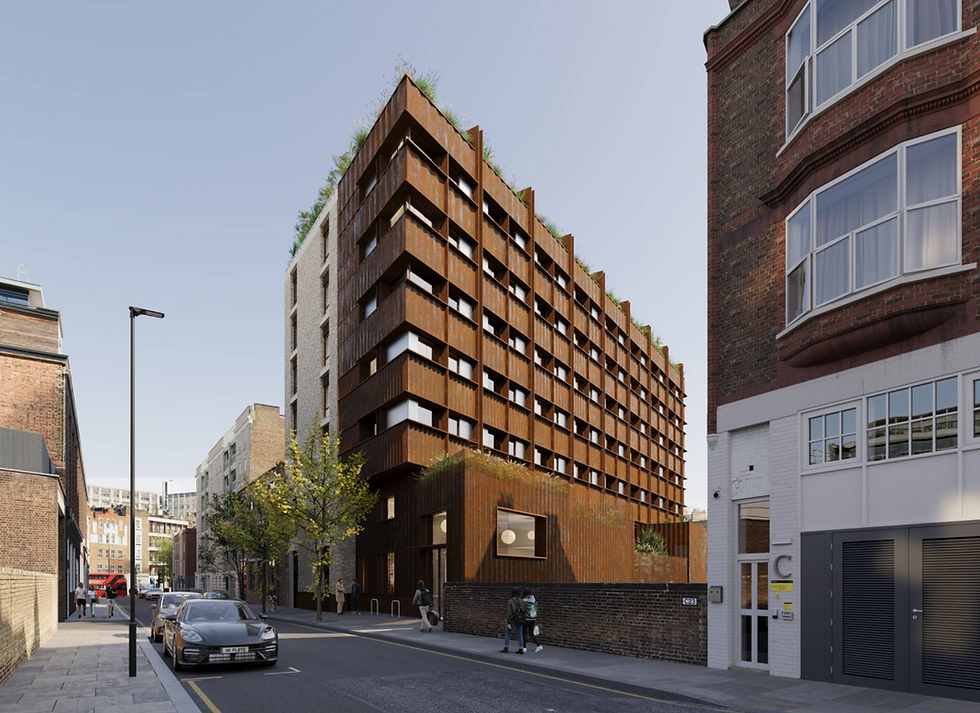
The same question applies at building scale. Canary Wharf Group’s plans for 10 Cabot Square show how far an office can change while retaining much of its structure. Cutting back the floorplates to improve daylight is a telling detail. Keeping the frame still leaves room to rethink how the building works, including what it offers people at street level.
At Portsmouth, the University and Morgan Sindall Construction are refurbishing and extending the Student Hub, with a link to the library. That connection is central to the project’s purpose: bringing student support and social learning closer to a place students already use. It’s a useful reminder that the value of an existing building often lies in what it connects to.
Liverpool’s Kings development takes a different route. GRAHAM is mobilising to build the first rental tower on a cleared site, and Beetham Davos says that building is fully funded by shareholders. With the wider masterplan application still to come, the first tower gives the developer something concrete to take into conversations with future occupiers.
This week’s stories show that often the best starting point for a project is the one that makes the next decision easier. Sometimes that means retaining a structure or putting existing infrastructure to work. Or funding a first building that provides financial viability in its own right, while the wider scheme takes shape. In each case, the value lies in what that first decision makes possible.
One to Watch: The first building as proof of concept
It’s worth watching how developers use the opening phase of large regeneration schemes to test their plans for what follows. A completed rental building can give future partners something tangible to assess and give the developer evidence of how residents use the space. The test is whether that evidence informs the later phases, when there is still time to change them.
Risk Radar: Power remains the critical issue for data centres
Co-locating data centres with existing generation makes sense where the opportunity exists, as with the Drax scheme. But the wider challenge is getting power to projects that depend on new grid connections. If those connections take longer to deliver than the facilities they serve, data centre growth will be limited by how quickly the power infrastructure can catch up.
Read our recent This Week columns
16th to 20th November 2026
What makes a site worth building on?
9th to 13th November 2026

A place in the bigger picture
2nd November to 6th November 2026

The work before the work
26th October to 30th October 2026